PPWR and corrugated board: Sipack technology supporting box manufacturers

From 12 August 2026, the European Packaging and Packaging Waste Regulation (PPWR, Regulation (EU) 2025/40) becomes fully applicable in all Member States. Unlike a directive, it is a regulation: it applies directly, without the need to be transposed into national law.
For a box manufacturer, this is a change that touches several fronts at once: more documentation to manage, packaging designed with less material, and a growing need to handle increasingly specific box variants. These are significant commitments, some of which are still not fully understood in terms of their practical application.
A regulatory framework still taking shape
The PPWR is a broad and detailed piece of legislation, and not all of its practical aspects have yet been defined down to the last detail. It is no coincidence that, in recent months, the European Commission itself has published several guidance documents to clarify the interpretation of certain provisions, in response to the numerous requests received from Member States, businesses and trade associations. This is worth keeping in mind: the overall framework is set out in the regulation, but several detailed technical criteria will be clarified over the coming months through delegated and implementing acts.
In this context, trade associations are playing an active role. Bodies such as CONAI and the main industry associations provide companies with webinars, FAQs and practical tools to help them navigate deadlines, documentation obligations and technical requirements, tracking regulatory developments and translating them into practical guidance. For a box manufacturer, relying on this support is probably the first step towards approaching the PPWR with a clear understanding, even before intervening on the production process.
The dates that matter
12 August 2026 – Full application of the Regulation. The core obligations kick in: declaration of conformity, restrictions on hazardous substances, and the requirement for traceable technical documentation. This is also the date from which the general principle of minimising packaging weight and volume takes effect, although its quantitative reference criterion will only become binding in 2030 (see below).
12 August 2028 – The obligation to use harmonised EU environmental labelling takes effect, gradually replacing current national systems, unless the Commission’s implementing acts (expected by 12 August 2026) are adopted later: in that case, the obligation applies 24 months after they enter into force.
1 January 2030 – The principle of minimising weight and volume, already in effect since 2026, becomes binding in its quantitative criterion: for e-commerce and transport packaging, empty space may not exceed 50% of total volume. Design tricks aimed solely at increasing the perceived volume of the box are also discouraged, in line with the minimisation principle already in effect since 2026. The official method for calculating the empty space limit will be defined by the Commission by 12 February 2028. From the same date, recyclability classes A, B and C also come into effect, though the detailed technical criteria (Design for Recycling) are still being defined through the expected delegated acts.
What changes in production
Three aspects directly impact the day-to-day work of a box manufacturer.
Weight and volume reduction
This is probably the change with the most immediate impact on production. It pushes towards boxes that are increasingly proportioned to the product, with less empty space and lower board weight for the same mechanical performance. The regulation does not require a greater number of formats, but it is likely to drive growing demand for right-sizing solutions — boxes increasingly “tailored” to the product — with a consequent increase in the variants to manage and the number of production changeovers.
Design for recycling
The future recyclability classes will favour mono-material packaging, free of elements that hinder component separation during recycling. Corrugated board starts from a favourable position: it is among the materials with the highest recycling target set by the PPWR for 2030 (85%, compared with the 70% overall average target), thanks to its high recyclability and the extensive use of recycled fibre in the sector. However, the design of die-cuts, laminates and finishes will need to take these criteria into account from the earliest stages of packaging development.
Substances and documentation
The regulation introduces restrictions on certain substances used in packaging, with particular attention also paid to packaging intended for food contact. This directly concerns processes typical of a box manufacturer, such as inks, adhesives and surface treatments. Here too, the practical details are subject to ongoing clarification, but the underlying principle — being able to demonstrate, with solid technical documentation, the compliance of the materials used — already applies from the outset, and the documentation must be retained for the periods set out in the regulation.
The real challenge: more variants, less time to adapt
Taken together, these obligations produce a very specific practical effect: box manufacturers will need to manage more formats, more production changeovers and increasingly tight margins for error, precisely at a time when raw material costs and the cost of regulatory compliance continue to place real pressure on many SMEs in the sector.
This is where production technology stops being a separate issue and becomes part of the response to the PPWR.
How Sipack helps manage the change
It should be said clearly: no machinery, however advanced, can guarantee PPWR compliance on its own. That remains a matter of packaging design, material selection and technical documentation management, to be addressed with the support of the right expertise and trade associations.
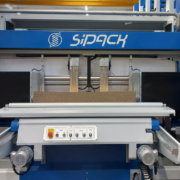
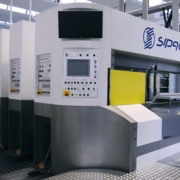
The PPWR does, however, also have an indirect operational effect that is difficult to avoid: as formats become more specific and less oversized, the number of variants to produce and format changeovers increases. In this scenario, having a plant designed for flexibility can make a concrete contribution to containing production time, costs and waste. On Sipack’s Royal VB DD flexo folder gluer lines, three features go precisely in this direction.
Slotter robot: fast format changeovers and tailored creasing
The slotter robot, with four pairs of shafts, automatically repositions the cutting heads directly from the HMI panel: the operator enters the data for the new box format and the machine adjusts itself automatically, with no manual tooling intervention required. As the number of variants grows, so does the number of format changeovers, and a faster, less error-prone process becomes all the more valuable as production variety increases.
The same principle of fast, precise repositioning also applies to creasing adjustment: being able to easily adjust both the cutting and creasing tools allows the box manufacturer to tailor the box ever more closely to the actual dimensions of the product. This is a direction consistent with that set out in the PPWR, which promotes packaging that is increasingly proportioned to the product, reducing empty space — where the packaging design calls for it — and avoiding tricks designed solely to increase the perceived volume of the box.
Direct-drive motors on every axis
Direct-drive motors on every axis, managed by Siemens automation systems with Motion System Control, ensure consistent precision throughout the process. With more frequent format changeovers, precise adjustment also helps reduce waste during line start-up — an aspect that matters increasingly as the number of formats to manage grows.
Lead Edge feeder: precision that supports weight reduction
The Lead Edge feeder manages sheet infeed at the start of the line with robust, independently adjustable gauges, ensuring the production process starts correctly even with sheets of suboptimal quality or that are warped. This aspect becomes even more relevant in light of the weight minimisation required by the PPWR: lower-weight board is generally less rigid and more prone to warping.
In summary
To date, the PPWR remains a regulation still being understood and developed: many detailed technical criteria still depend on delegated and implementing acts that the European Commission has yet to issue, and industry associations are themselves working to translate them into clear operational guidance for businesses. In this evolving scenario, being able to count on a reliable technology partner makes the difference: with Sipack, box manufacturers have access to plants designed to ensure flexibility, precision and operational speed — concrete support for facing, with greater confidence, the changes the PPWR will bring to day-to-day production.
If you’d like to explore how a Royal VB DD flexo folder gluer line could help your plant respond more flexibly to the changes required by the PPWR, get in touch at sales@sipack.it — we’re happy to discuss your production needs.