In recent years, corrugated cardboard converting has been facing an increasingly evident production evolution: the growth of e-commerce, the increase in product variants and the fragmentation of orders are leading to more variable production runs, with frequent job changes and progressively shorter print runs.
According to FEFCO, corrugated cardboard packaging now represents a central element of European e-commerce logistics, in a market where speed, customisation and operational continuity are redefining supply chain requirements.
Production dynamics among converters are also changing rapidly. The growth of SKUs and the need to manage increasingly differentiated production runs are putting growing pressure on setup times, process repeatability and the ability of lines to maintain consistent quality even with continuous format changes.
In this scenario, the challenge is no longer simply about increasing production speed, but ensuring stability and efficiency even under operating conditions that are far more variable than in the past.
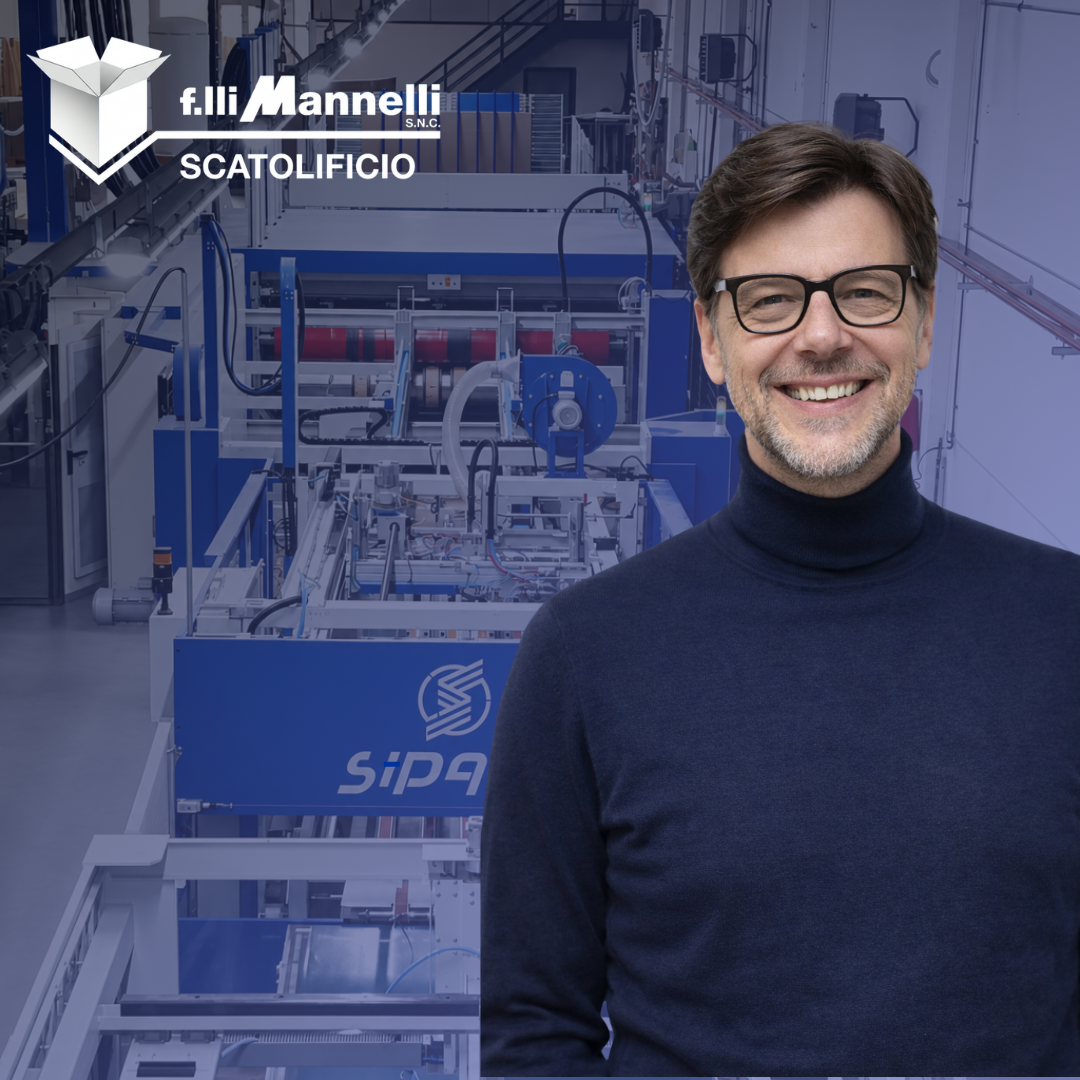
We spoke with Gianluca Giometti, Technical Director of SIPACK, to explore how these developments are influencing the design of converting machinery.

How are the requirements of converting lines changing?
Today, lines must handle a much higher level of variability than in the past. This creates growing pressure on setup speed, process stability and production continuity, as machines must maintain consistent performance even when switching rapidly from one job to another.
For this reason, what matters today is not just the maximum speed of the line, but above all its ability to maintain quality, precision and repeatability even with highly variable production runs.
How is SIPACK responding to these new production requirements?
At SIPACK, we are working on several fronts, directly addressing all the factors that affect production continuity and the reduction of format changeover times.
The goal is to make setup faster, more repeatable and less dependent on manual adjustments — through quick-change format systems, optimisation of box positioning and solutions that speed up and stabilise the production start-up phase.
At the same time, we have enhanced the performance of our different machine series — Minidrive, Onedrive and Royal VB DD — to meet increasingly dynamic production demands, where converters today require not only high speeds but also consistent quality between one job and the next.
With this in mind, in developing our Royal rotary die-cutter we have focused heavily on process stability even with short runs and frequent format changes, while maintaining very high quality standards.
A particularly critical aspect concerns printing on coated board, where even minor variations in pressure or uniformity can affect the final result. For this reason, the machine is designed to ensure high precision, print uniformity and operational stability, delivering an exceptionally sharp output even on variable production runs.
The ultimate goal is not just to reduce setup times, but to make the process more stable, repeatable and less dependent on the individual operator’s experience.
Another increasingly relevant issue for the sector is the growing difficulty in finding skilled operators — how much does this affect line management?
The shortage of experienced operators is becoming an increasingly structural factor and is directly influencing the way machines are designed.
Today it is essential to make lines more intuitive, guided and straightforward to manage, reducing dependence on individual skills and increasing operational standardisation.
This becomes even more important in production environments with high staff turnover or multiple shifts.
What is SIPACK’s approach on this front?
To address these needs, SIPACK has developed a touch Totem positioned directly along the line, designed to guide the operator through the critical phases of the process and make machine management more immediate and intuitive.
The system provides real-time production parameters, operational information and machine status updates, reducing dependence on the individual operator’s experience.
In this way, even less experienced personnel can achieve consistent results and manage the line with greater operational confidence, as many control and adjustment tasks are supported directly by the system.
Integration with company ERP/MES systems also ensures greater coherence between planned and actual production, improving traceability, operational control and production continuity across different shifts.
The goal is not simply to digitalise the machine, but to concretely simplify the operator’s work, making the process more stable, repeatable and controllable.
As we have seen, the landscape is increasingly complex and fragmented. SIPACK’s objective is to interpret manufacturers’ needs and translate them into concrete technical solutions, capable of delivering the expected results in terms of market competitiveness, productivity and final product quality.